
Sheep Cookies
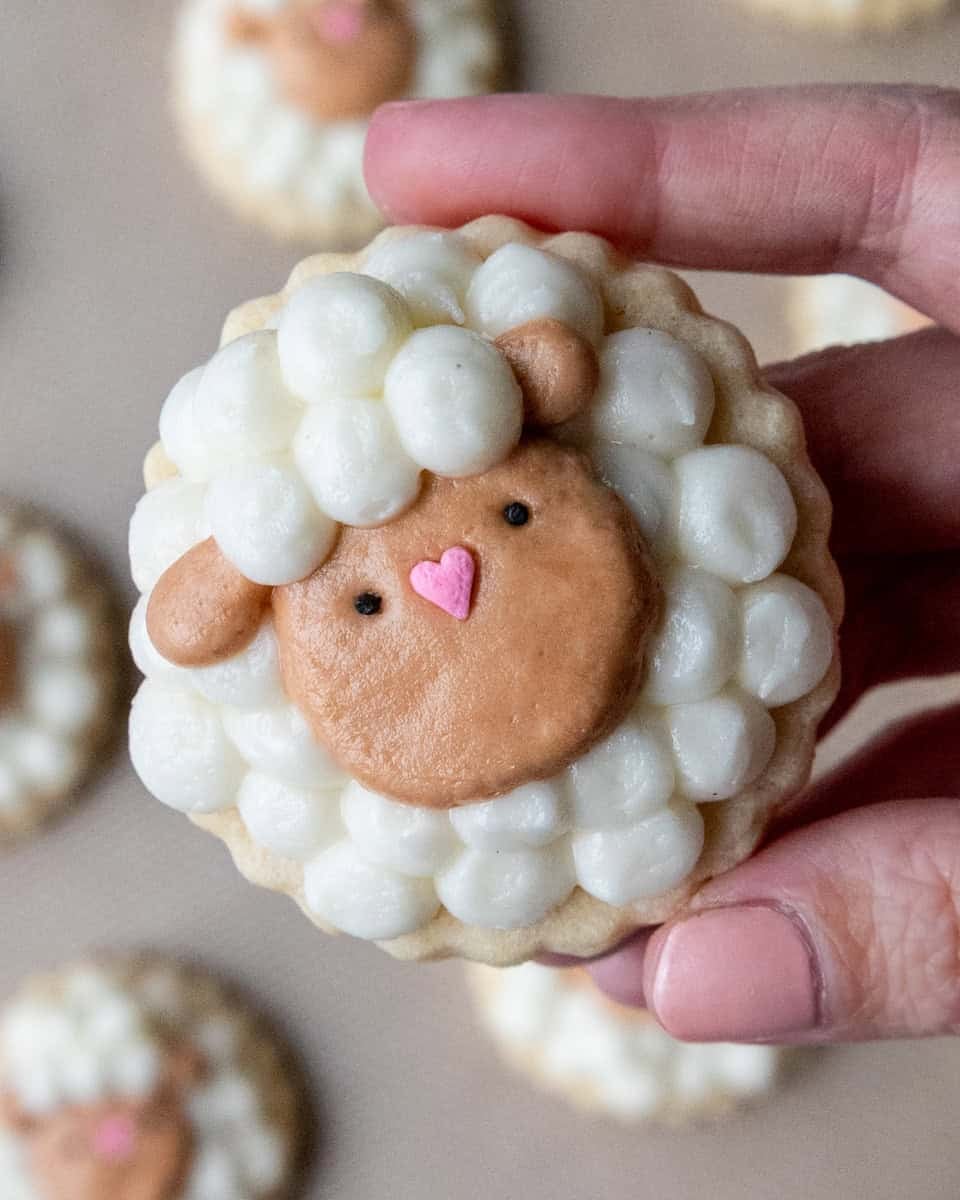
These buttercream sheep cookies bake up soft and chewy and are topped with delicious homemade buttercream frosting.
Why You’ll Love These Sheep Cookies
- Soft Cream Cheese Sugar Cookie Base – These cookies are made with a cream cheese sugar cookie dough that bakes up soft, tender, and flavorful while still holding its shape beautifully.
- They Don’t Spread While Baking – Thanks to a proper chill time and the perfect flour-to-fat ratio, these cookies keep their clean edges and scalloped shape in the oven.
- Perfect for Easter or Spring Parties – These decorated sheep cookies are ideal for Easter dessert tables or Easter cookie boxes, spring celebrations, farm-themed birthdays, or baby showers.
- Easy to Decorate with Buttercream – No complicated royal icing required! Simple piping techniques with buttercream make these adorable sheep cookies approachable for beginner decorators.
Let’s Make These Decorated Sheep Cookies Together
Let’s walk through each step of this recipe to make sure it turns out as amazing as possible!
I’ve also shared a video tutorial on how to make them in the recipe card at the bottom of this post, along with the tools I used. If you don’t have all of these on hand, feel free to get creative and work with what you’ve got!
Step 1: Make the Cookie Dough
The first step is to make the cookie dough! Follow the recipe card at the bottom of this post to make the dough.
I’ve tested this cream cheese sugar cookie base dozens of times, and I love how it holds its shape beautifully when decorated.
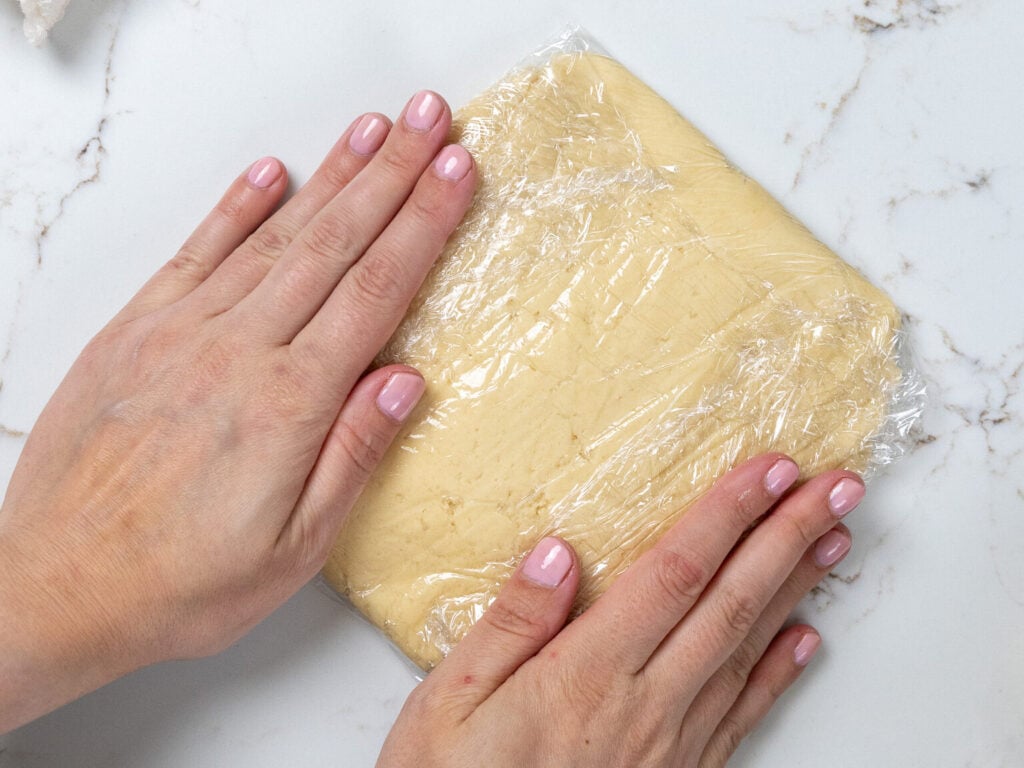
Then divide the dough in half and wrap each piece of dough in a piece of plastic wrap.
Chill in the fridge for about 2 hours or in the freezer for 30 minutes. You can also chill the dough overnight.
Step 2: Roll and Cut Out the Cookies
Preheat the oven to 350°F/175°C for about 30 minutes before you plan to roll out the dough and line two large baking sheets with silicone baking mats or parchment paper. Set aside.
Generously dust the surface you plan to roll the cookies out on with additional flour. Take one of the dough rectangles out of the fridge or freezer, leaving the other to continue to chill.
Sprinkle some more flour on top of your dough and your rolling pin.
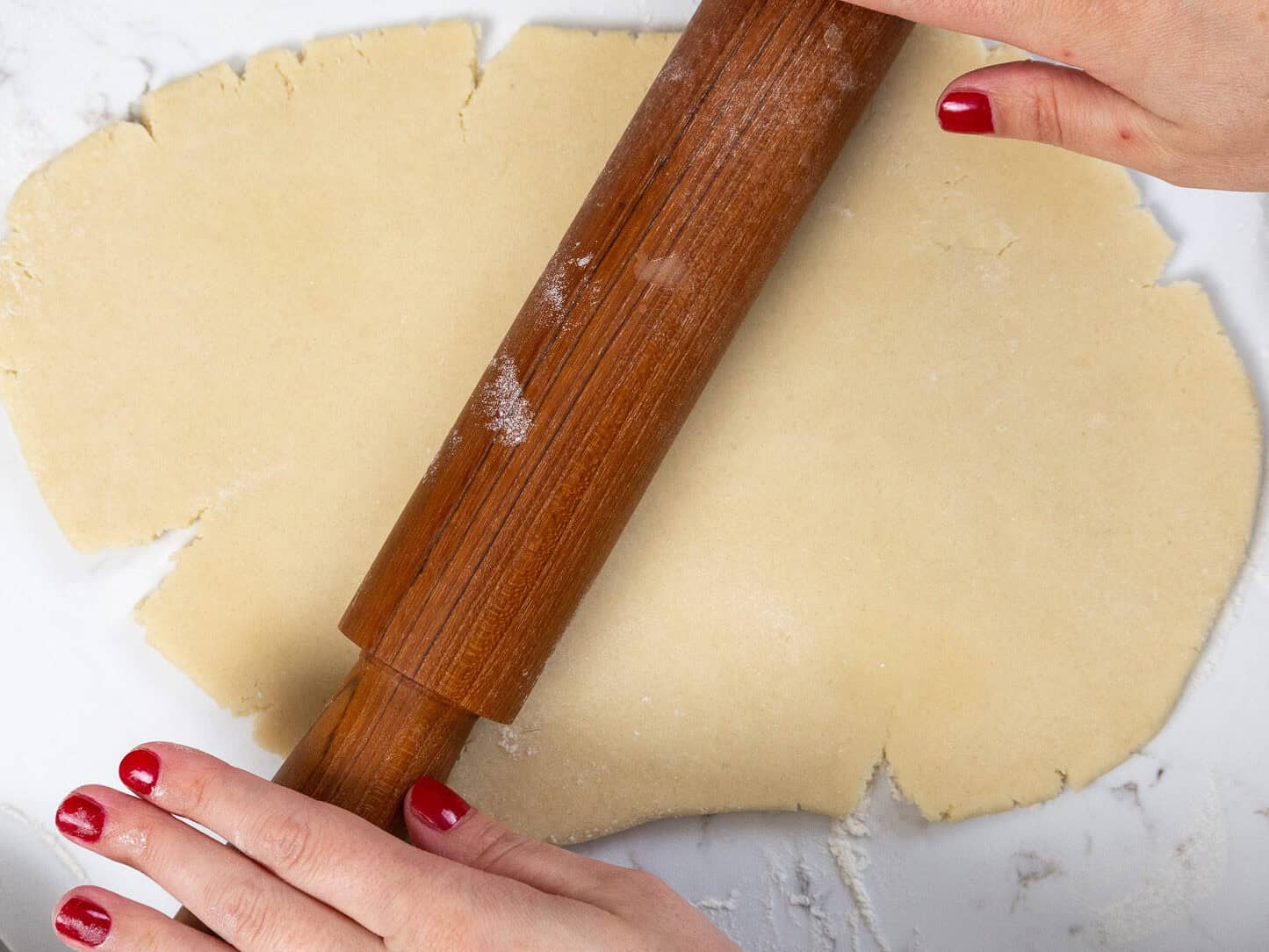
Roll the chilled dough to be 1/3 inch thick and cut out as many circles as possible with a flour-dusted round cookie cutter. I used a 2-inch wide scalloped cookie cutter.
Use a kitchen brush to gently brush off any excess flour and place them 1 inch apart on the prepared baking sheets.
Chill the cut-out cookies one more time in the fridge for 15 minutes or the freezer for 5 minutes to help them keep their shape as they bake.
Step 3: Bake the Cookies
Bake for 12-15 minutes on the middle rack of your oven (time varies based on the size and thickness of the cookies).
Keep a close eye on the cookies and be sure to pull them out before the edges start to brown. Let the baked cookies cool on the pan for about 15 minutes, then transfer to a wire rack to finish cooling.
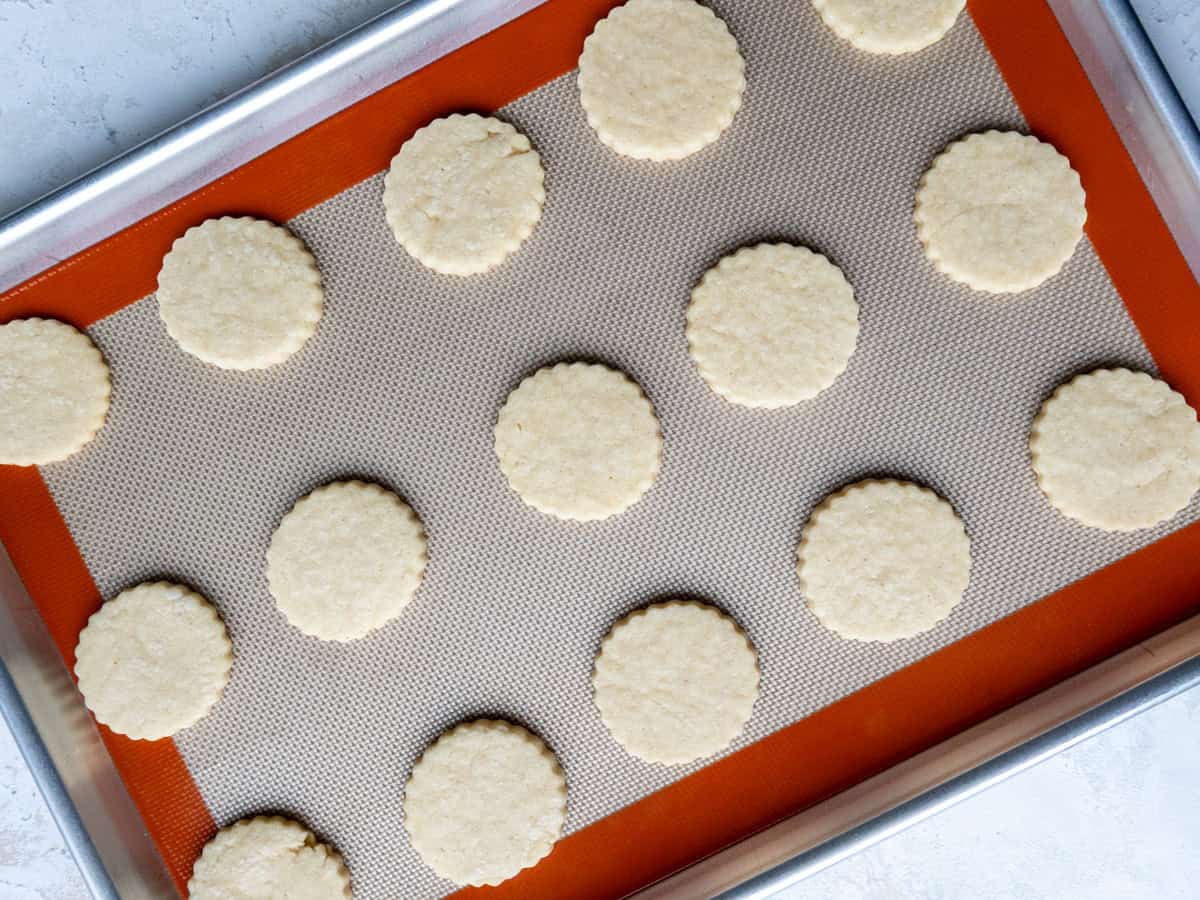
While the first batch bakes and cools, knead together the cookie dough scraps and rewrap them in plastic wrap.
Pop them back in the fridge to chill. Pull out your 2nd chilled piece of dough and repeat the steps above. Then repeat with the chilled dough scraps.
Step 4: Make the Buttercream
While the cookies bake and cool, make the buttercream frosting.
If the frosting seems too thick, add an extra Tbsp of heavy cream. If it seems too thin, add another 1/4 cup of powdered sugar.
Or if you’re unsure what consistency the frosting should be, check out my frosting consistency guide.
Once the frosting is made, stir it by hand with a rubber spatula to get it SUPER smooth.
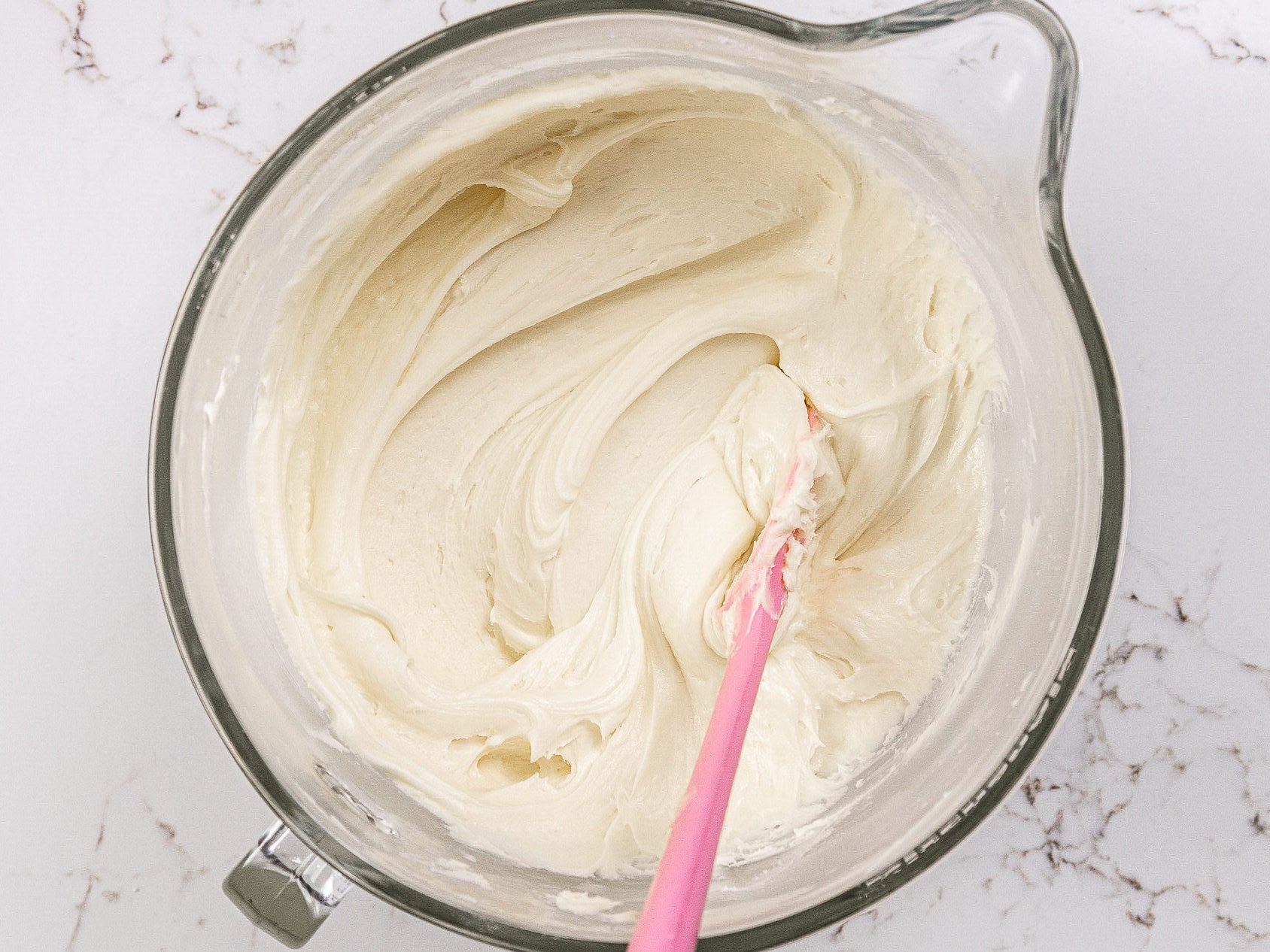
Color 1 1/2 cups of buttercream brown with a small drop of brown gel food coloring. Place 1 cup of this frosting in a small piping bag fitted with a large round piping tip like a Wilton 1A (or cut an opening that’s about 1/2 inch wide).
Scoop the remaining 1/2 cup of frosting in a small piping bag fitted with a small round piping tip like a Wilton 5 (or cut an opening that’s about 1/4 inch wide).
Place the remaining white frosting into a large piping bag fitted with a small round piping tip, like a Wilton 5 (or cut an opening that’s about 1/4 inch wide).
Step 5: Frost and Decorate the Sheep Cookies
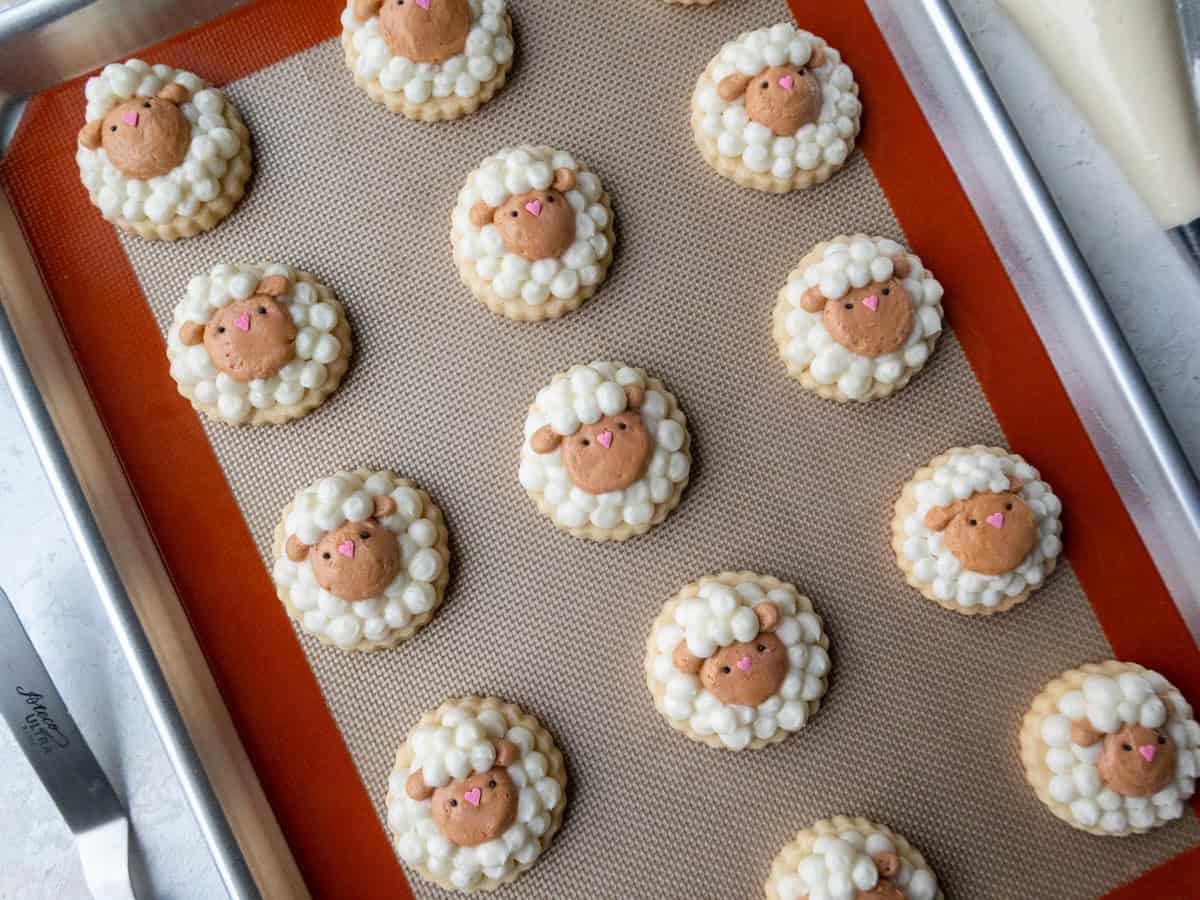
Once the cookies have fully cooled, use the white buttercream and brown buttercream to pipe the sheep’s wool and face.
Place a heart-shaped sprinkle in the center of the face, then add two small black sprinkles to be the sheep’s eyes.
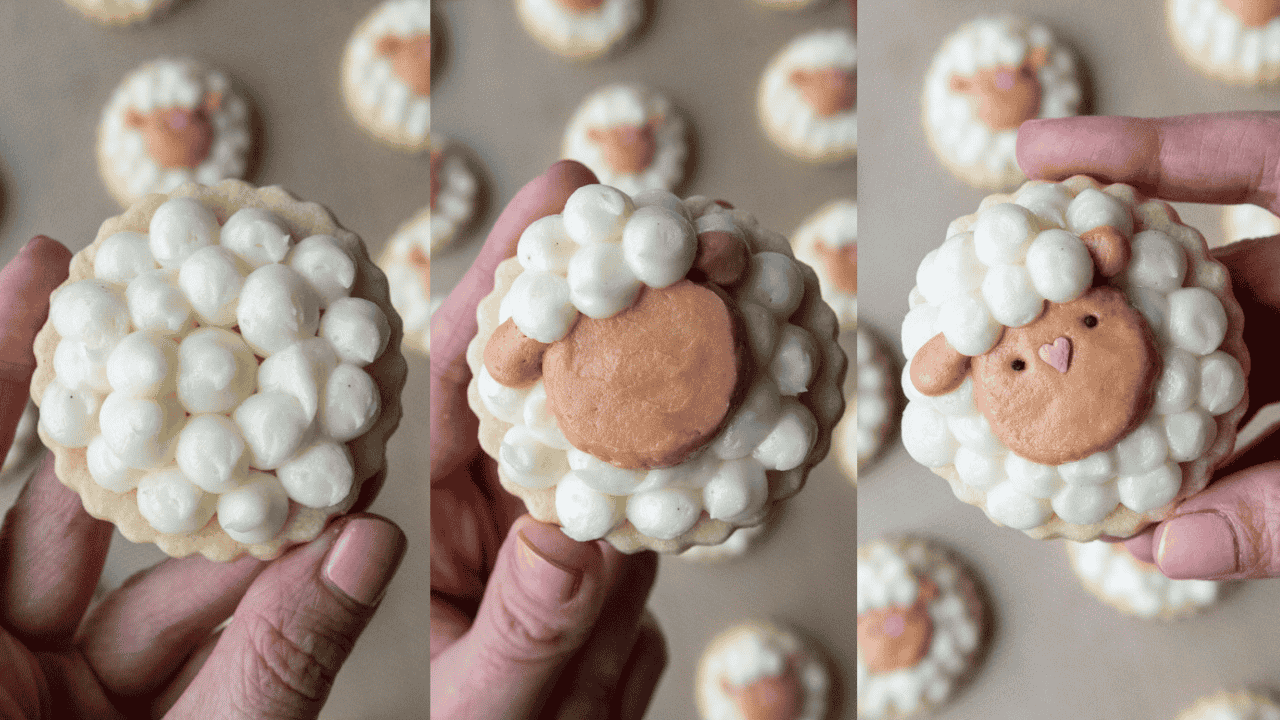
Repeat with the remaining cookies, then enjoy! These can be stored in an airtight container at room temperature for up to a day, kept in the fridge for up to 5 days, or kept in the freezer for up to 2 months.
Substitutions and Swaps – Cookie Dough
This recipe uses quite a few ingredients, and I know you might not have them all on hand.
Or if you have food allergies or restrictions, I’ve got you covered. Below are some swaps and substitutions that you can make.
- Granulated Sugar – I do not recommend reducing the amount of sugar or changing the type of sugar, as it will change the spread of these cookies.
- Unsalted Butter – If you only have salted butter on hand, you can use it in place of the unsalted butter. Just be sure to omit the salt that this recipe calls for. You can also use vegan butter in its place (and omit the salt)!
- Cream Cheese – Full-fat cream cheese that comes in a block works best.
- Large Egg – If you have an egg allergy, try using a flaxseed egg or a vegan egg replacer like this one made by Bob’s Red Mill.
- All-Purpose Flour – This recipe turns out best with AP flour, but you can use a gluten-free flour blend if needed.
- Cornstarch – Cornstarch helps give these cookies a soft texture! If you don’t have any on hand, it can be omitted, but your cookies won’t bake up as soft.
Substitutions and Swaps – Buttercream Frosting
- Unsalted Butter – If you only have salted butter on hand, you can use it in place of the unsalted butter. Just be sure to omit the salt that this frosting recipe calls for. You can also use vegan butter in its place.
- Heavy Cream – Whipping cream, coconut cream, or alternative milk (soy, almond, oat, coconut) will work fine in this frosting recipe if that’s what you have on hand.
- Vanilla Extract – Other extracts can also be used in place of the vanilla extract if needed.
- Almond Extract – Optional, but I think it really enhances the flavor! You can also use another extract in its place or omit it completely.
How Many Cookies Does This Recipe Make?
This recipe can be used to make 36 2-inch cookies. The yield and bake time will vary based on the size and shape of the cookie cutter you use.
Tips for Making the Best Easter Sheep Cookies
- Really cream together the butter, cream cheese, and granulated sugar in the first step of this recipe. It helps incorporate air into the dough, which makes fluffy and soft cookies.
- Roll the cookie dough out to a consistent thickness of 1/3 inch. If some are thicker or thinner than others, they may over- or under-bake in the oven.
- Chill the cookie dough. It helps prevent your cookies from spreading while they bake.
- Don’t overbake the cookies. Err on the side of underbaking your cookies, and remember that the cookies continue to bake for a few minutes once they’re out of the oven.
- If you want these to set firmly, you can use my royal icing recipe to decorate them.
- Feel free to get creative with what you use to make the sheep’s face and work with what you’ve got! You can also use fondant if needed.
Making These Sheep Cookies in Advance and Storage Tips
You can store frosted cookies in an airtight container for up to a day at room temperature, up to 5 days in the fridge, or for up to a month in the freezer.
If you want to stack the cookies on top of one another, I recommend chilling them thoroughly before doing so and adding a layer of parchment paper between them. The buttercream will firm up when it’s chilled, but won’t set hard like royal icing.
This cookie dough can also be frozen for up to 1 month if wrapped tightly in plastic wrap and stored in an airtight container. If I do freeze the cookie dough, I like to move the cookie dough to the fridge the night before I plan to roll it out and bake the cookies.
Baked, unfrosted cookies can also be frozen! These cookies last for up to a month if frozen in an airtight container.
I recommend waiting to frost them until they’ve thawed to room temperature.
Move them to the fridge the day before you plan to eat them, then let them sit out at room temperature for a few hours before frosting them.
Let Me Know What You Think!
If you try this recipe for sheep cookies, I’d love to hear what you think! Please leave a rating and let me know your thoughts by sharing a comment.

Sheep Cookies
Equipment
- 2-Inch Scalloped Circle Cutter
- 2 Small Piping Bags or Freezer Ziplock Bags
Ingredients
Soft Buttercream Cookies
- 3/4 cup (1 1/2 sticks) unsalted butter, room temperature 170g
- 1/2 cup full-fat cream cheese, room temp 113g
- 1 1/2 cups granulated sugar 300g
- 1 large egg, room temperature 56g
- 2 tsp vanilla extract or vanilla bean paste 10g
- 1 tsp almond extract, optional 5g
- 3 cups all-purpose flour 375g
- 1 Tbsp cornstarch 8g
- 1 tsp fine salt 6g
- 1/2 tsp baking powder 2g
Buttercream Frosting
- 1 cup unsalted butter, room temperature 226g
- 2 tsp vanilla extract or vanilla bean paste 10g
- 1 tsp almond extract 5g
- 1/2 tsp fine salt 3g
- 3 1/2 cups powdered sugar 454g or 1 lb. box
- 1/4 cup heavy whipping cream, room temperature 60g
- Brown gel food coloring
Additional Decorations
- black sprinkles (for the eyes)
- pink heart sprinkles (for the noses)
Instructions
Cream Cheese Cookies
- In a large bowl or the bowl of a stand mixer, beat 3/4 cup (170g) butter and 1/2 cup (113g) cream cheese on medium speed with a hand mixer or whisk attachment until smooth.
- Next, add 1 1/2 cups (300g) granulated sugar and mix on a medium-high speed for a couple of minutes, until the mixture becomes lighter in color.
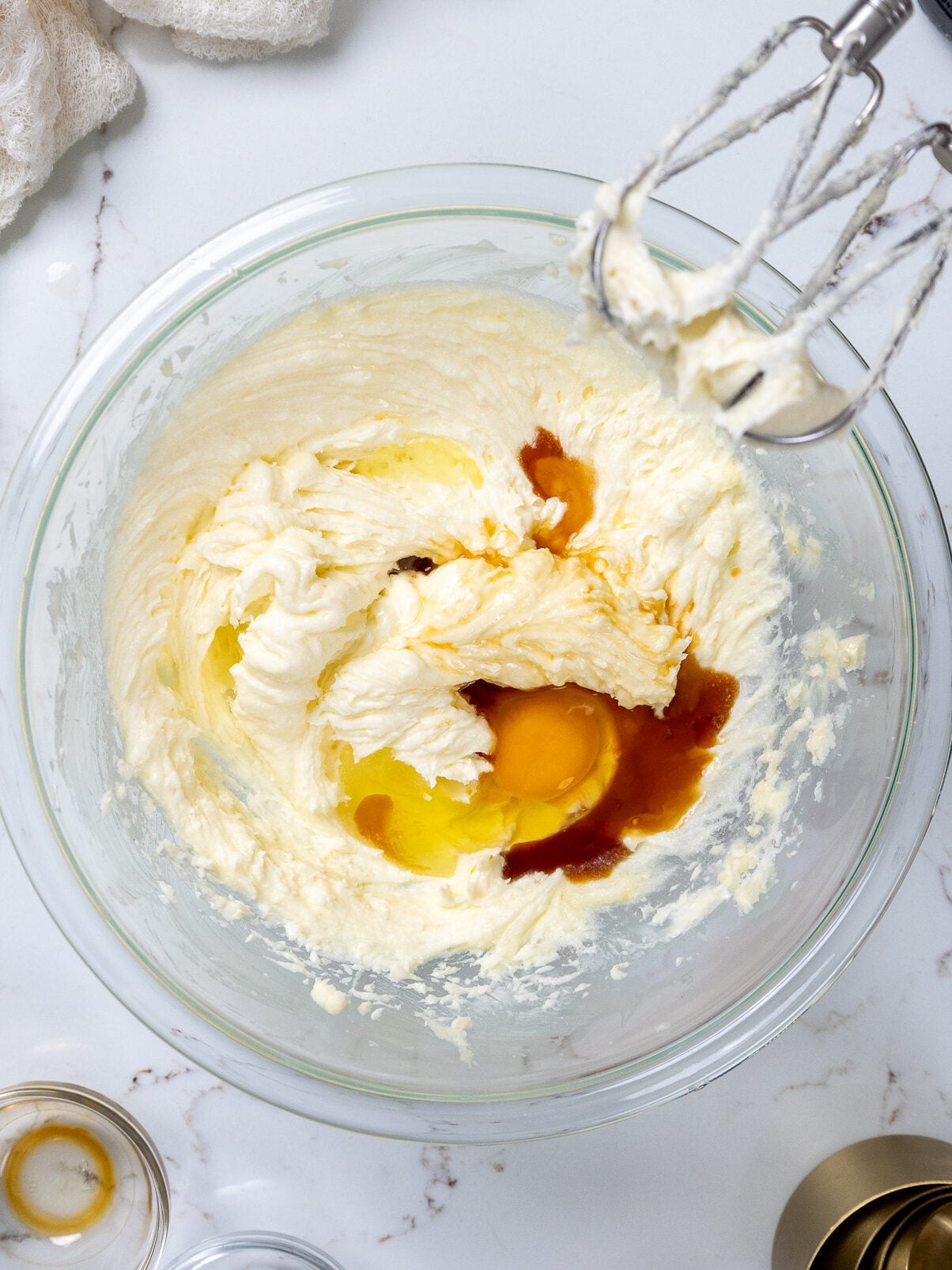
- Then, add 1 egg (56g), 2 tsp (10g) vanilla bean paste or vanilla extract, and 1 tsp (5g) almond extract (optional). Mix on a medium speed until incorporated.
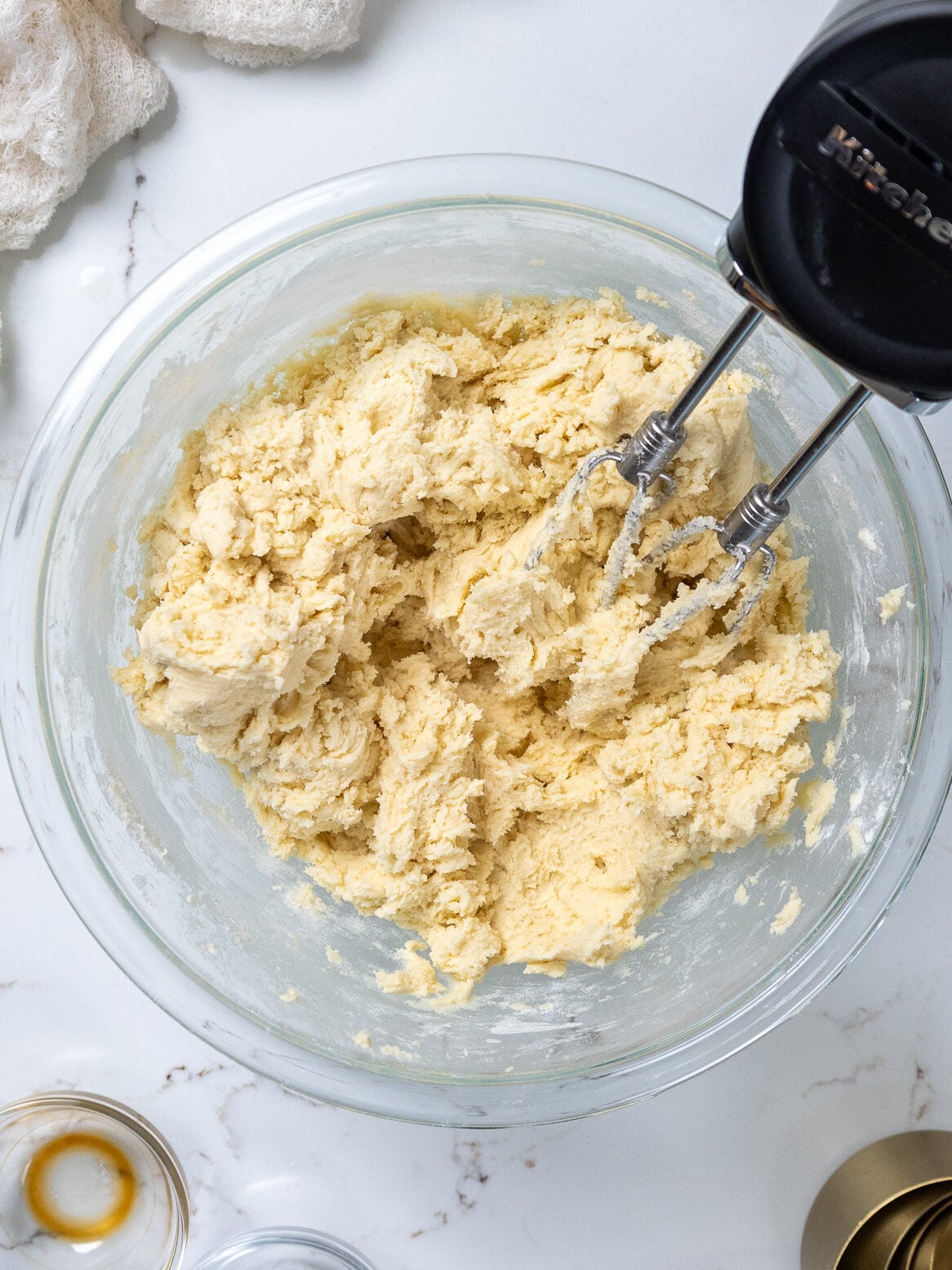
- In a separate bowl, whisk together 3 cups flour (375g), 1 Tbsp cornstarch (8g), 1 tsp fine salt (6g), and 1/2 tsp baking powder. Add the flour mixture into the butter mixture and mix on a low speed until it is JUST incorporated. Scrape the sides and bottom of the bowl with a rubber spatula to make sure everything is properly mixed together.
- At this point, the dough should still be pretty sticky. Divide the dough in half and wrap each portion of dough in a piece of plastic wrap. I like to flatten the dough out into a rectangle that's 1/3 inch tall, so that I don't have to roll it out when it's chilled.
- Chill the dough in the fridge for about 2 hours, in the freezer for 30 minutes, or in the fridge overnight. If you chill the dough overnight, let it sit out at room temperature for about 10 minutes before trying to roll it out. This will make it easier to roll out!
- Preheat the oven to 350°F/175°C for about 30 minutes before you plan to roll out the dough, and line two large baking sheets with silicone baking mats or parchment paper. Set aside.
- Take one piece of dough out of the fridge, leaving the other in there to continue to chill. Unwrap the cookie dough and lay the plastic wrap out flat on your counter. We will be rolling out the cookie dough on the plastic wrap to make cleanup a breeze and to make it easier to cut out the cookies. Dust both sides of the cookie dough and your rolling pin with flour.
- If it isn't already, roll the dough to be 1/3 inch thick and cut out cookies with a 2-inch round or scalloped cookie cutter. Use a kitchen brush to brush any excess flour off the cookies and place them on the prepared baking sheets. The cookies don't spread much as they bake, so you can place them about 1 inch apart.
- Chill the cut-out cookies one more time in the fridge for 15 minutes or the freezer for 5 minutes to help them keep their shape as they bake.
- Bake one sheet of cookies at a time. Bake for 12-15 minutes on the middle rack of your oven (bake time will vary based on the size and shape of the cookies). Keep a close eye on the cookies and be sure to pull them out before the edges start to brown.
- Let the baked cookies cool on the pan for about 15 minutes, then transfer to a wire rack to finish cooling.
- While the first batch bakes and cools, knead together the cookie dough scraps and rewrap them in plastic wrap. Pop them back in the fridge to chill.
- Pull out the 2nd chilled portion of dough and repeat the steps above. Then repeat with the chilled dough scraps.
Buttercream Frosting
- Beat 1 cup (226g) of butter on a medium speed for 30 seconds with a paddle attachment, until smooth.
- Mix in 2 tsp (10g) vanilla paste or vanilla extract, 1 tsp (5g) almond extract (optional), and 1/2 tsp fine salt on a low speed.
- Gradually mix in 3 1/2 cups (454g) powdered sugar and 1/4 cup (60g) of heavy cream. Scrape the sides and bottom of the bowl as needed with a rubber spatula. Beat on low until the ingredients are fully incorporated and the desired consistency is reached.
- If the frosting seems too thick, add additional cream (1 Tbsp at a time). If the frosting is too thin, add more powdered sugar (a quarter of a cup at a time).
- Scoop about 1 1/2 cups of buttercream into a separate bowl and use a small drop of brown gel food coloring to make light brown frosting. Place 1 cup of this frosting in a small piping bag fitted with a large round piping tip like a Wilton 1A (or cut an opening that's about 1/2 inch wide). Scoop the remaining 1/2 cup of frosting in a small piping bag fitted with a small round piping tip, like a Wilton 5 (or cut an opening that's about 1/4 inch wide).
- Place the remaining white frosting into a large piping bag fitted with a small round piping tip, like a Wilton 5 (or cut an opening that's about 1/4 inch wide).
Decorating the Sheep Cookies
- Once the cookies have fully cooled, use the white buttercream to pipe little dots or swirls that cover the entire cookie.
- Use the brown buttercream with the large round piping tip to pipe a circle in the center of the cookie to look like the sheep's face. Use a small offset spatula or an acetate sheet to smooth out the frosting. Then use the brown buttercream with the smaller piping tip to add on the ears. Pipe a few more swirls of white buttercream above the head to give the cookie a little more dimension.
- Place a heart-shaped sprinkle in the center of the face, then add two small black sprinkles to be the sheep's eyes. I only had the long, narrow type of black sprinkles, so I pushed them into the frosting so that just the end showed, but any type of small black sprinkle will work!
- Repeat with the remaining cookies, then enjoy! These can be stored in an airtight container at room temperature for up to a day, kept in the fridge for up to 5 days, or kept in the freezer for up to 2 months.
Video
Notes
Making These Sheep Cookies in Advance and Storage Tips
You can store frosted cookies in an airtight container for up to a day at room temperature, up to 5 days in the fridge, or for up to a month in the freezer. If you want to stack the cookies on top of one another, I recommend chilling the cookies thoroughly until the buttercream is firm to the touch and then adding a layer of parchment paper between them. The buttercream will crust, but it won’t set hard like royal icing. This cookie dough can also be frozen for up to 1 month if wrapped tightly in plastic wrap and stored in an airtight container. I like to move the cookie dough to the fridge the night before I plan to roll it out and bake the cookies. Baked, unfrosted cookies can also be frozen! These cookies last for up to a month if frozen in an airtight container. I recommend waiting to decorate them until they’ve thawed to room temperature. Move them to the fridge the day before you plan to eat them, then let them sit out at room temperature for a few hours before frosting them.Tips for Making the Best Sheep Cookies
- Really cream together the butter, cream cheese, and granulated sugar in the first step of this recipe. It helps incorporate air into the dough, which makes fluffy and soft cookies.
- Roll the cookie dough out to a consistent thickness of 1/3 inch. If some are thicker or thinner than others, they may over- or under-bake in the oven.
- Take the time to chill the cookie dough. It helps prevent your cookies from spreading while they bake and helps them bake up with a soft texture.
- Don’t overbake your cookies. Err on the side of underbaking your cookies and remember that the cookies continue to bake for a few minutes once they’re out of the oven.
Nutrition
Other Recipes You Might Like:


These lamb cookies are absolutely adorable. I plan to make them for an upcoming baby shower and wanted to know if you could provide a link to the heart sprinkles you used for the nose?
Thank you Anna! The heart sprinkles I used aren’t available on Amazon anymore, but I believe these are similar sized sprinkles: https://amzn.to/3RrHy6V
Hope that helps and that your cookies turn out great!