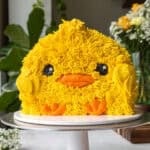
Chick Cake
This adorable chick cake is made with tender lemon cake layers and decorated with homemade vanilla buttercream. It's perfect for Spring, Easter, or even a farm animal party!
Servings: 16
Calories: 667kcal
Equipment
- 2, 8-inch cake pans
- 2 Small Piping Bags or Freezer Ziplock Bags
- 1 Large Grass Piping Tip (Like a Wilton 234)
- 2 Medium Round Piping Tips - Like a Wilton 10
Ingredients
Lemon Cake Layers
- 2 cups granulated sugar 400g
- 1 Tbsp fresh lemon zest (zest of 1 large lemon) 6g
- 2 cups + 2 Tbsp all-purpose flour 270g
- 1 1/2 tsp baking powder 6g
- 1/2 tsp fine salt 3g
- 2/3 cup (1 1/3 sticks) unsalted butter, room temperature 150g
- 2/3 cup carton egg whites or 5 large egg whites, room temperature 155g
- 1 cup buttermilk, room temperature 240g
- 1 Tbsp vegetable or canola oil 14g
- 1 tsp vanilla extract or vanilla bean paste 4g
- 1 tsp lemon extract (optional)
- gel food coloring if desired
Vanilla Buttercream Frosting
- 2 cups unsalted butter, room temperature 452g
- 7 cups powdered sugar 907g or a 2 lb bag
- 1/4 cup heavy whipping cream, room temperature 60g
- 1 Tbsp vanilla extract or vanilla bean paste 12g
- 1/2 tsp fine salt 3g
- yellow, orange, and black gel food coloring
Instructions
Lemon Cake Layers
- Preheat oven to 350°F. Line two 8-inch cake pans with parchment paper, then grease them with nonstick spray. Set aside.
- In a small bowl, add 2 cups (400g) granulated sugar and the zest of a large lemon (about 1 Tbsp/6g). Use your fingertips to massage the zest into the sugar. The rubbing action releases the natural oils from the zest, intensifying the citrus flavor throughout the sugar.
- Add the lemon sugar made in the step above, 2 cups + 2 Tbsp all-purpose flour (270g), 1 1/2 tsp baking powder, and 1/2 tsp fine salt in a large bowl. Use a stand mixer and paddle attachment or a hand mixer to mix on a low speed until combined.
- Mix 2/3 cup (1 & 1/3 sticks or 150g) unsalted butter slowly into the dry mix, on a medium-low speed. Continue to mix until no large chunks of butter remain, and the mixture becomes crumbly.
- Pour in 2/3 cup (155g) or about 5 egg whites and mix on low until just incorporated and the batter looks wet.
- Then mix in 1 cup (240g) of buttermilk, 1 Tbsp of vegetable oil, 1 tsp vanilla extract, and 1 tsp lemon extract (optional) on a low speed. Scrape the sides and bottom of the bowl as needed with a rubber spatula, then beat on a medium speed for about a minute to make sure everything is properly mixed together. This also helps lighten the texture of the cake layers a bit.
- Divide batter evenly between the prepared cake pans. I like to use a kitchen scale to weigh my pans and ensure they all have the same amount of batter. This guarantees your layers will bake to the same height.
- Bake for 33–35 minutes, or until a toothpick comes out with a few moist crumbs. Let the cake layers cool in the pans for 10–15 minutes, then run a small offset spatula around the perimeter of each pan and carefully turn the layers onto wire racks.
- Fully cool or chill the cake layers before leveling and assembling. Use a serrated knife to level the tops of the layers right before you plan to assemble your cake.
Vanilla Buttercream Frosting
- While the cake layers bake and cool, make the vanilla buttercream frosting.
- Beat 2 cups of unsalted butter on medium speed for 30 seconds with a paddle attachment or hand mixer until smooth.
- Slowly mix in 7 cups of powdered sugar on a low speed, 1 cup at a time. Halfway through, add 1/4 cup of heavy cream or 2 Tbsp of milk (milk thins it more) to make it easier to mix.
- Scrape the sides and bottom of the bowl as needed with a rubber spatula.
- Once the frosting is fully mixed and smooth, add 1 Tbsp of vanilla extract and 1/2 tsp salt. Mix on the lowest speed for a couple of minutes to help make the frosting silky smooth. If the frosting seems too thick, add additional cream (1 teaspoon at a time). If the frosting is too thin, add in more powdered sugar (a quarter of a cup at a time). If you're unsure how thick your frosting should be, check out my frosting consistency post.
- Scoop 1/3 cup of buttercream into a separate, small bowl and color it orange with gel food coloring. Place in a small piping bag fitted with a medium round piping tip (like a Wilton 10). If you don't have that type of piping tip, you can just cut a 1 cm opening at the base of the piping bag. Set aside.
- Scoop 1/4 cup of buttercream into a separate, small bowl and color it black with gel food coloring. Place in a small piping bag fitted with a medium round piping tip (like a Wilton 10). If you don't have that type of piping tip, you can just cut a 1 cm opening at the base of the piping bag. Set aside.
- Color the remaining buttercream yellow with gel food coloring. Cover the frosting flush with plastic wrap to prevent crusting.
To Assemble The Cake
- If you plan to turn the cake on its side like I did, leave the parchment paper attached to the bottom cake layer, and place it on a greaseproof cake board or flat plate. If you don't, remove the parchment rounds from the bottom of the cake layers and add a dab of frosting to keep the bottom cake layer in place.
- Spread an even layer of yellow buttercream on the first cake layer, and top it with the second cake layer. Use a sharp knife to cut off a thin strip on one side of the cake. Mine was about 2 inches tall (see pictures above). This is optional, but it allows us to stack the cake layers on their side (and as a bonus, you get to snack on the cut-off piece).
- Add a very thin coat of frosting around the cake, then chill the cake in the fridge (20 minutes) or freezer (10 minutes) until the frosting is firm to the touch.
- Gently lift the cake to flip it on its side, and spread some frosting onto the cake board where you plan to place the cake to help keep it in place. Spread a very thin layer of frosting on the back of the cake. Place the remaining yellow buttercream in a large piping bag fitted with a large grass piping tip.
- Use the black frosting to add eyes to the front of the cake, and the orange frosting to add the beak and the feet. Then pipe the yellow frosting all around the cake to look like fluffy feathers. Be careful around the eyes, beak, and feet, making sure you don't cover them. Take breaks as you go to give your hand a rest.
- Then pipe wings on the side of the cake with yellow buttercream and enjoy!
Video
Notes
Tips for Making the Best Chick Cake
- Properly measure your flour (spoon into the cup measure, then level) or use a kitchen scale.
- Make sure your ingredients are at room temperature to help them mix together better.
- Don't level and torte your cake layers until they are completely cooled.
- Make sure your buttercream is the right consistency. This will help give your cake proper structure and make it easier to decorate.
- If your cake layers turn out less than perfect, read my cake troubleshooting guide to see where things might've gone awry.
Nutrition
Serving: 1 | Calories: 667kcal | Carbohydrates: 90g | Protein: 4g | Fat: 34g | Saturated Fat: 21g | Polyunsaturated Fat: 2g | Monounsaturated Fat: 9g | Trans Fat: 1g | Cholesterol: 87mg | Sodium: 404mg | Potassium: 70mg | Fiber: 0.5g | Sugar: 77g | Vitamin A: 1025IU | Vitamin C: 1mg | Calcium: 55mg | Iron: 1mg