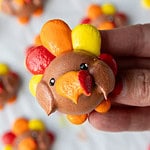
Meringue Turkeys
These adorable little meringue turkeys are the perfect Thanksgiving treat! They're light, airy, and perfectly crunchy with chewy centers.
Servings: 24 turkeys
Calories: 34kcal
Equipment
- 1 Large Round Piping Tip - Like a Wilton 2A
- 3 Medium Round Piping Tips - Like a Wilton 10
- 1 Small Round Piping Tip - Like a Wilton 3
Ingredients
Meringue Turkeys
- 4 large egg whites, room temperature 120g
- 1/4 tsp cream of tartar - optional
- 1 cup superfine caster or granulated sugar 200g
- 1/2 tsp vanilla or almond extract - optional 3g
- Red, orange, yellow, brown, and black gel food coloring
- 48 white nonpareil sprinkles (for the eyes - optional)
Instructions
Turkey Meringues
- Preheat the oven to 200°F/93°C and line a large baking sheet with parchment paper or a silicone mat. Set aside.
- Before you whip up the meringue, make sure there are no traces of grease on the whisk attachment or in your bowl. Grease can prevent the meringue from whipping up properly. If you see or feel any grease, moisten a paper towel with vinegar and wipe the inside of the bowl and the whisk attachment to remove any grease.
- Then add 4 large, room-temperature egg whites into the bowl of a stand mixer with a whisk attachment and mix on medium speed until the surface of the egg whites is covered in small bubbles. Add 1/4 tsp cream of tartar and continue to mix until it reaches the soft peak stage and leaves visible tracks.
- Gradually mix 1 cup of granulated sugar, 1 Tbsp at a time, into the egg whites over a few minutes while mixing on a medium-low speed. Adding the sugar gradually makes a huge difference in the meringue's stability. Increase the mixing speed to a medium-high speed (6 on a KitchenAid). When the meringue gets close to reaching stiff peaks, add 1/2 tsp of vanilla or almond extract. Keep mixing until stiff, glossy peaks form.
- Scoop about one-third of the meringue into a separate bowl and color it a light golden brown with a generous squirt of brown gel food coloring. Fold the food coloring into the meringue gently, and mix just until it's evenly colored. If you overmix the meringue, it will lose some of its structure and be more difficult to pipe. Scoop it into a large piping bag fitted with a large round piping tip (like a Wilton 2A). If you don't have a piping tip that size, cut an opening at the base of the bag that's 1/4 inch wide. Seal the top of the bag with a clip or rubber band.
- Scoop 2 Tbsp of meringue into a separate bowl and color it black with a very large squirt of black gel food coloring. Scoop it into a small piping bag fitted with a small round piping tip (like a Wilton 3).
- Divide the remaining meringue into three parts and color them yellow, orange, and red with gel food coloring. Scoop each color into its own piping bag fitted with a medium round piping tip (like a Wilton 10).
- Immediately pipe the turkeys once the meringue is colored. The meringue loses its structure as it sits, so you don't want to dilly-dally. Start by piping the turkey feathers with the red, orange, and yellow meringue. Then pipe orange dollops beneath the feathers to be the turkey's feet. Then pipe a large mound of brown meringue over the feathers and partially over the feet (see picture above for reference).
- Use the orange meringue to add the beak, the red meringue to make the snood (the red dangly bit next to the beak), and then the black meringue to add the eyes. The last step is to pipe little wings on the sides of the turkey with brown meringue. You can also add white nonpareils to the eyes if you want them to have a bit more dimension. These don't spread as they bake, so they can be piped about 1 inch apart.
- Bake the tray on the middle rack of your oven for 2 hours and 30 minutes, then turn the oven off and let the meringues sit in the oven for another hour. You can also leave them in the oven overnight once you turn it off. I usually do this and find I have the best results this way. Letting them gradually cool helps prevent cracking. At this point, the meringues should look and feel dry to the touch. If they still seem wet or moist, leave them in the oven for another hour.
- Remove the tray from the oven and let the meringues cool fully to room temperature. They should have a crunchy exterior and a soft, chewy center. Store them in an airtight container at room temperature for up to 2 weeks. Avoid refrigerating or freezing them, since condensation can make them soft and sticky.
Video
Notes
Tips for Making the Best Turkey Meringues
- With the total bake and cool time, these need to be in the oven for at least 3 1/2 hours, if not overnight. I like to make them at the end of the day so they don't interfere with other baking.
- Separate your eggs while they're still cold. They separate more easily cold, but let the whites come to room temperature before whipping.
- Use gel food coloring. Liquid food coloring can thin the meringue and make it less stable.
- Beat the meringue on medium-high rather than the highest speed to create smaller, more stable air bubbles.
- Bake time can vary depending on the size of the turkeys and the piping tips used. Once baked and cooled, they should peel cleanly from the parchment or silicone mat.
- If they get sticky or soft, bake them at 200°F for 10–15 minutes, then let them cool completely in the turned-off oven.
Nutrition
Serving: 1 | Calories: 34kcal | Carbohydrates: 8g | Protein: 1g | Fat: 0.03g | Sodium: 8mg | Potassium: 8mg | Sugar: 8g | Calcium: 0.4mg | Iron: 0.01mg